In the intensely competitive world of modern serious sliding, success is no longer purely a function of sheer horsepower or behind-the-wheel courage. Conversely, it has evolved into a multifaceted discipline that necessitates a painstaking blend of choosing a proven chassis, arming it with the most precise competition components, and, most critically, grasping its real-time behavior on the course through cutting-edge vehicle dynamics analysis tools. This definitive manual functions as your master plan starting from the initial idea of a project car right through to the last telemetry-optimized refinements that transform a strong car into a consistent champion. We will thoroughly explore the methodical process of vehicle alignment optimization, showing how a state-of-the-art drift tuning app like a dedicated telemetry system eliminates approximation and provides unparalleled insight into your vehicle's true performance.
The bedrock of any great drift machine is, indisputably, the base vehicle itself. Certain platforms have attained iconic status within the global drifting scene due to their inherent balance, strong construction, and the enormous range of specialist components available. Selecting the optimal car is the first and most important selection a driver will make. For instance, the BMW's E36 3 Series is universally acknowledged as one of the best all-around drift platforms of the modern era. Its near-perfect balanced front-to-rear weight, coupled with a driven rear axle configuration and extremely reliable six-cylinder motors, forms a chassis that is both easy to handle for beginners and incredibly competitive in the possession of a professional pilot. The evolution of this philosophy, the BMW E46, refines these qualities with a even more sophisticated chassis, increased wheel track for greater high-speed stability, and even a greater degree of steering angle as standard from the OEM. A different formidable option in the professional arena is the Chevrolet Corvette C6.
This muscle-derived sports car offers a particular combination of advantages to the sliding world, featuring a low-mass alloy chassis, a backwards-positioned drivetrain component that aids in an perfect balance, and the colossal low-end power of a big LS V8 motor. This blend makes it an complete monster on track, able of starting and sustaining long angles with apparently minimal deployment of throttle. For drivers desiring remarkable performance per dollar, the 350Z model Nissan stands out as a top-tier example. It comes from the manufacturer with a rigid platform, a decent factory limited-slip differential, and the free-revving VQ series motor that delivers plenty of performance for practicing and progressing in the discipline. Its newer version, the 370Z model, brings further refinements in chassis stiffness, steering geometry, and peak powerplant performance, establishing its position as a favorite selection among professional pilots. Further legendary cars that merit mention encompass the nimble unique Mazda FC RX-7, the ever-present Nissan S13, the American Ford Mustang SN95, the electronic-equipped E90 3 Series, and the small yet surprisingly engaging and forgiving Mazda Miata. Every single one of these cars provides a distinct set of characteristics, difficulties, and capabilities, but they all have in common the core ingredients required to become a serious sliding vehicle.
However, choosing the correct chassis is just the first step. To unlock the complete potential of every of these machines, substantial upgrades to the steering geometry and damping and springing systems are absolutely mandatory. This is where the realm of performance tuning parts comes into sharp focus. The single most game-changing improvement for a dedicated drift car is the integration of a drift-spec angle modification kit. These engineered systems, like those manufactured by performance brands like SLR, are engineered to dramatically expand the vehicle's maximum steering angle. A factory production vehicle is highly constrained in how far its steering tires can pivot, a safety limitation for daily operation. In oversteer driving, conversely, aggressive countersteering is continuously needed to control and hold a drift. An steering kit exchanges the OEM hubs, tie rods, and sometimes suspension arms with pieces that allow the front tires to reach steering lock in excess of 70 or even 80 degs, versus a normal OEM limit of around 40 to 50 °.
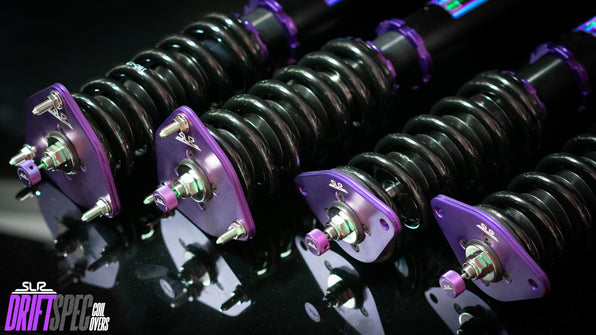
This immensely increased lock provides the pilot with significantly greater authority during a slide, enabling it to be far more straightforward to initiate a drift, hold it through a extended corner, and switch fluidly from one angle to the opposite. The difference in handling is nothing short of transformative. Combined with a correctly selected modification is the just as critical enhancement to the car's suspension. Generic or including high-end sport adjustable suspension are simply not intended for the specific and brutal needs of sliding. A dedicated pair of coilovers is of utmost importance. These specific coilovers incorporate unique piston tuning and spring strength that are designed for the rapid load shifting that is inherent of drifting. When a driver initiates a angle, the chassis's inertia is transferred rapidly to the outer of the turn. Proper drift-spec suspension control this movement in a predictable manner, allowing the car to stabilize promptly and offering the driver precise response through the controls and seat. They also allow for exact tuning of ground clearance, shock absorber rate, and corner weighting, which are all integral parts of fine-tuning the vehicle's handling to a particular circuit or piloting technique. In combination, a top-tier angle modification system and a correctly chosen set of performance coilovers constitute the absolute physical cornerstone upon which all subsequent optimization is based.
Once the core hardware is in place, the following vital phase in the project is the detailed tuning of the vehicle's wheel angles. This is the domain of vehicle alignment optimization, a process that can appear intimidating to the newcomer but is, in reality, the secret to turning a collection of capable components into a harmonious and controllable whole. The most discussed aspect of suspension geometry for drifting is certainly camber. Camber angle is the tilt of the tire relative to the vertical axis when observed from the front of the chassis. If the upper part of the wheel is leaning towards the car, this is called negative camber. In oversteer driving, negative camber on the front axle wheels is universally applied and is regarded as critical. The logic is deeply tied to vehicle dynamics.
When a chassis is turning at limit sideways angles, the body tilts toward the external of the turn. This chassis roll forces the outside front wheel to lose its ideal footprint with the asphalt. By adding inward lean, the wheel is pre-leaned to counteract this tilt. As the car tilts into the corner, the tire becomes more upright against the asphalt, optimizing its traction at the critical moment when it is needed most for steering authority. Typically, front axle camber settings for a serious drift car range from approximately -3 degrees to as high as -5 degrees or even greater, depending on the parameters of the car configuration, rubber type, and driver preference. The rear axle wheels also utilize inward lean, but the values are usually less and less aggressive than the front axle. Overly aggressive negative camber at the rear can cause the vehicle to extremely prone to oversteer and difficult to predict on acceleration application, as it reduces the usable tire footprint of the powered wheels during straight-line power delivery. Thus, rear axle adjustments are frequently in the vicinity of -1 degree to -3 degrees, finding a delicate equilibrium between offering enough lateral grip to help in entering and holding the angle while still preserving effective traction for exiting the bend. camber angle is just one component of the broader tuning picture, which furthermore includes toe angle, caster angle, and bump steer adjustment.
Toe setting refers to the direction of the wheels when looked at from above. Inward toe means the leading edges of the tires are closer together than the trailing edges, while outward toe means the opposite. For oversteer, a small amount of front axle toe out is commonly employed to sharpen the turn-in steering feel, making the car feel more responsive and eager to begin a drift. Rear axle toe is generally set to zero or a incredibly slight amount of positive toe to promote straight-line stability under power. self-centering is the frontwards or aft angle of the suspension pivot when viewed from the side-on of the vehicle. More caster angle increases steering feel and stability confidence, and it also boosts inward lean effect during turning, which is highly useful. Tuning these parameters is a intricate interplay where a modification to one value can and will affect the remaining parameters. The traditional process for dialing in a chassis's suspension geometry for sliding has historically been a time-consuming process of experimentation and feeling. A pilot or crew would make a modification based on intuition, test the car on track, depend on the pilot's subjective feel and impressions, and then apply another tweak. This loop would repeat time after time until the vehicle felt "good" or the available practice time ended. This approach is not only exceptionally slow in terms of man-hours and tires, fuel, and parts, but it is also deeply inaccurate.
Human sensation is a infamously unreliable data source, affected by many variables such as fatigue, changing track grip levels, weather, and just the mood of the driver on that given run. What feels "oversteery" on one run might feel "tight" on the subsequent pass, resulting in confusing feedback and counterproductive tweaks. This long-standing problem in car suspension tuning is specifically where state-of-the-art engineering tools has stepped in to revolutionize the landscape.
The development and adoption of advanced drift telemetry software has ushered in a new era for tuning and perfecting professional drift machines. These systems, exemplified by innovative systems like data acquisition tools, work by physically capturing the real-time physical performance of the car as it is being driven on the course. As opposed to depending on subjective feedback, these systems gather measurable information on key parameters such as damper compression and extension, corner velocities, acceleration forces, lock position, and driver input input. This acquired information flow is then analyzed by sophisticated algorithms that can graph and analyze the information in a comprehensible manner. For the first time, drivers and builders can visualize precisely what the car is doing at every point of a lap. This ability transforms the entire chassis setup workflow. Think about the specific goal of optimizing the front camber for a specific chassis. Rather than applying a adjustment from -3 degrees to -3.5 degrees and then testing several runs to try and "perceive" a improvement, a telemetry system can give immediate and definitive information. The tool can display visually how the wheel's grip is behaving during the critical phases of a drift: turn-in, sustain, and switch. It can demonstrate if the current camber setting is allowing the outside front tire to achieve maximum grip or if the rubber is over-stressed on its outer shoulder.
The system can subsequently suggest empirical advice for adjustment. Perhaps the telemetry indicates that the outside front tire is still stressing its edge at -3.5 degrees of camber, implying that a move towards inward lean, say -4 degrees, might be advantageous. Conversely, the data might reveal that the tire is failing to coming up to heat or that the inner edge is degrading excessively, which could indicate that there is too much negative camber and a modest decrease back to -3.2 degrees would be more optimal. This level of precision and useful analysis was simply unattainable in the time of pure manual adjustment.
The effect of employing a comprehensive suspension tuning tool reaches far beyond just dialing in alignment. It becomes an invaluable suspension tuning guide that is tailored to vehicle dynamics tool your particular vehicle. When fine-tuning the damping settings on your suspension, rather than depending on vague advice or replicating another car's settings, you can use the telemetry to analyze how the vehicle is reacting in relation to your adjustments. The application can display the suspension travel path over a run, showing if the shocks are controlling the chassis motion optimally or if they are causing the car to oscillate too much after a transition. It can assist in diagnosing issues like hitting the bump stops or excessive extension, enabling you to make educated adjustments to preload settings, rebound/compression rates, or ride height. This methodology translates just as well to the detailed task of suspension geometry optimization. In addition to camber angle, the software can give data into how changes to toe and caster angle are impacting the chassis's stability during specific parts of a drift. For instance, it can help you to determine the optimal amount of front negative toe for your individual angle kit geometry and piloting technique by measuring the speed of turn-in reaction and the stability of the vehicle at full countersteer. This transforms the tool an incredibly powerful vehicle dynamics manual that is dynamically informed by the real-world performance of your own chassis on the tarmac. It elevates the entire process from a subjective skill into a methodical optimization exercise.
Furthermore, the value of a system like drift tuning app data acquisition is not confined to expert teams with large budgets. For the amateur competitor, it serves as an amazing educational tool. It practically offers the tuner with the knowledge of a professional race engineer without requiring the corresponding cost. It speeds up the learning curve by delivering unambiguous directions to problems that would otherwise take countless track days of trial and error to solve. A builder can see how their particular chassis reacts to different settings, building a more intuitive understanding of suspension theory in the endeavor. It furthermore makes accessible professional chassis dynamics concepts, enabling all drivers with the desire to perfect their car to achieve it in a structured and productive fashion. This is particularly significant in a sport like sliding, where engineering knowledge has historically been a closely guarded asset among top teams. Today, that knowledge can be in the toolkit of any motivated enthusiast.
In the final analysis, the journey to constructing and tuning the ideal competitive sliding vehicle is a multi-stage mission that seamlessly blends classic hardware knowledge with revolutionary telemetry technology. It starts with the informed choice of a legendary chassis, then enhanced by the application of essential competition components suspension engineering like high-performance angle modification systems and properly specified performance coilovers. The journey then moves into the intricate realm of chassis dynamics adjustment, where parameters like negative camber, toe, and caster angle are carefully configured to match the chassis's new geometry and the operator's individual needs. Ultimately, and what really separates the contemporary approach from the old ways, is the use of a sophisticated suspension tuning application. This tool removes the approximation and inefficiency of solely seat-of-the-pants tuning by delivering empirical, real-time telemetry on how the chassis is actually behaving. It serves as an indispensable suspension tuning tool, a definitive drift suspension tuning guide, and a comprehensive chassis development system. In unison, this complete methodology guarantees that all aspect of the competition vehicle—from the selection of the platform to the final adjustment on the suspension—is optimized for peak success on the track. It signifies the total evolution of the discipline of oversteer driving, bridging raw car control with data-informed suspension engineering to build the ultimate dominant vehicles possible.